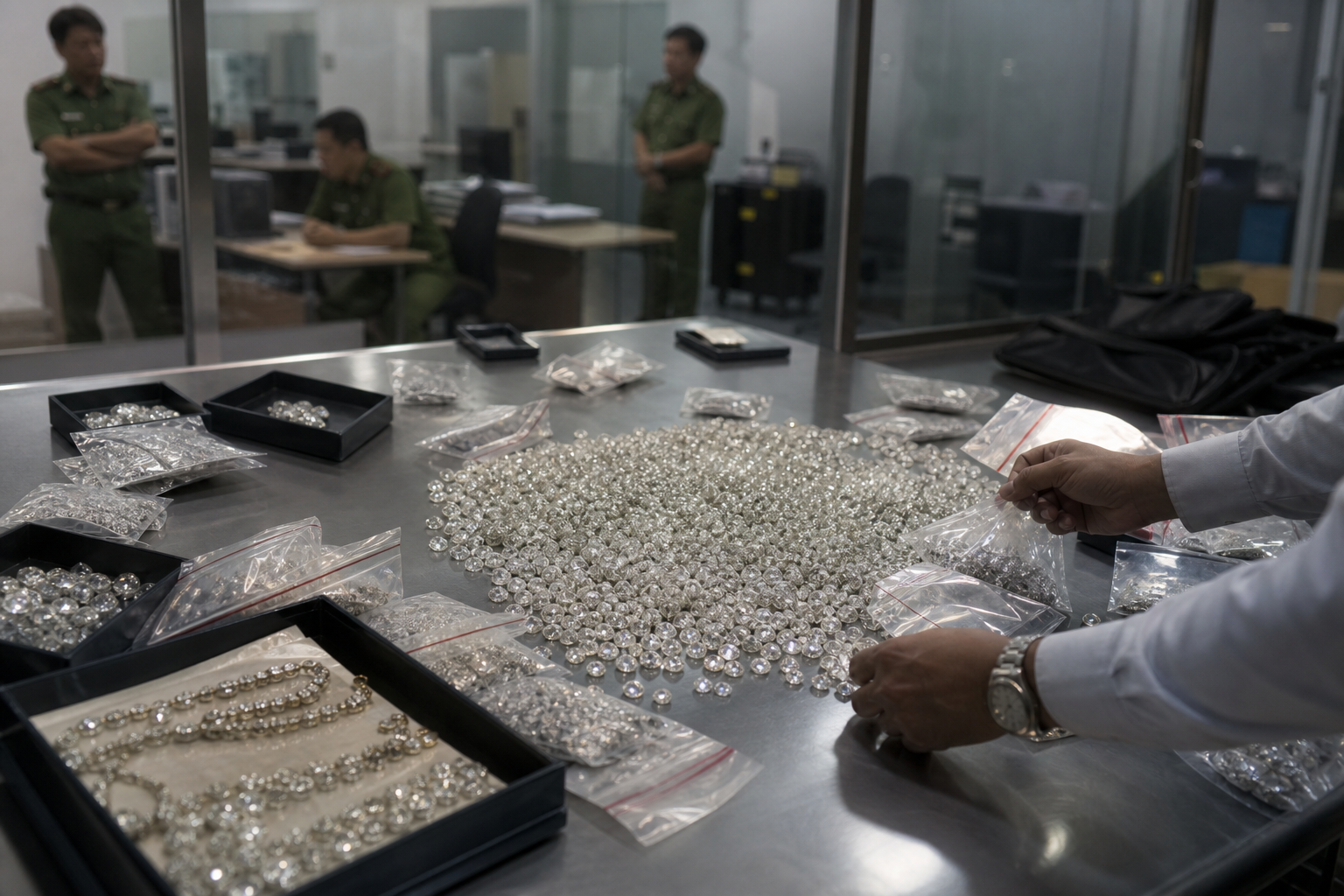
Investigators in Thanh Hoa province have charged four more suspects in a cross-border diamond smuggling case tied directly to Vietnam's state-owned jeweller SJC, bringing the total haul into focus: more than 3,400 diamonds worth an estimated VND 500 billion (roughly USD 20 million) were funnelled through SJC's retail network between 2022 and 2024. The latest arrest sweep on July 20, 2026 also seized an additional 354 stones valued at approximately VND 68.8 billion.
Inside the Smuggling Chain
Authorities say the operation ran from Hong Kong to Ho Chi Minh City through a structured supply chain. Le Thuy Hang, who served as SJC's chief executive during the relevant period, allegedly directed the scheme from the top, instructing the company's sales director, Pham Thi Hong Duyen, to source the stones illegally. Duyen placed orders and received shipments, while middlemen Tran Cong, Tran Huu Thanh Quan, and Hoang Trung Bac handled the physical handoff and sale to SJC.

How the Diamonds Were Laundered
The paper-trail manipulation was methodical. Duyen recorded the smuggled stones in SJC's internal management system as purchases from individual retail customers — effectively disguising bulk contraband as routine second-hand buybacks. Once the paperwork was in order, the diamonds were sent in small batches to Rong Vang SJC, the company's own gemological certification unit, for grading and authentication. Splitting shipments into small lots avoided triggering volume-based alerts. After certification, the stones entered SJC's warehouse and distribution pipeline as fully documented inventory.

SJC's Structural Vulnerability
The case exposes a conflict of interest that regulators had not adequately addressed: a state-owned retailer controlling its own certification subsidiary. Because Rong Vang SJC both graded and cleared the stones for sale, the smuggled diamonds passed through what appeared to be an arms-length quality check but was in practice an internal gateway. The scheme relied heavily on that structural gap — without independent third-party certification, the laundering mechanism held together for nearly three years.

Sentences and Ongoing Probe
Le Thuy Hang was already convicted on separate charges of embezzlement and abuse of office and sentenced to 22 years in prison. The four suspects charged on July 20 — Duyen, Tran Cong, Tran Huu Thanh Quan, and Hoang Trung Bac — now face smuggling charges. Thanh Hoa's Economic Crime Police unit describes the case as ongoing, with investigators still working to map the full network, pursue additional suspects, and recover remaining contraband.
Scale and Market Implications
VND 500 billion over two years represents a significant volume for Vietnam's premium jewellery retail segment. SJC holds a dominant position in Vietnam's gold and gemstone market as a state-backed brand, which lends its retail certificates a level of consumer trust that private operators rarely match. That credibility, investigators suggest, was precisely what made the SJC retail channel attractive as an exit point for smuggled goods — the brand name functioned as an implicit guarantee of origin.
Investor Takeaway
For companies assessing Vietnam's luxury goods and precious-metals sector, the case signals that compliance frameworks at state-owned enterprises remain uneven. The use of an internal certification unit to validate inventory sourced through illegal channels points to governance weaknesses that go beyond individual bad actors. Regulators are likely to tighten oversight of gemstone provenance documentation and may revisit the rules around in-house certification subsidiaries. Investors or retailers sourcing from or partnering with Vietnamese jewellery distributors should treat third-party, independent gemological certification as a baseline requirement rather than an optional premium.