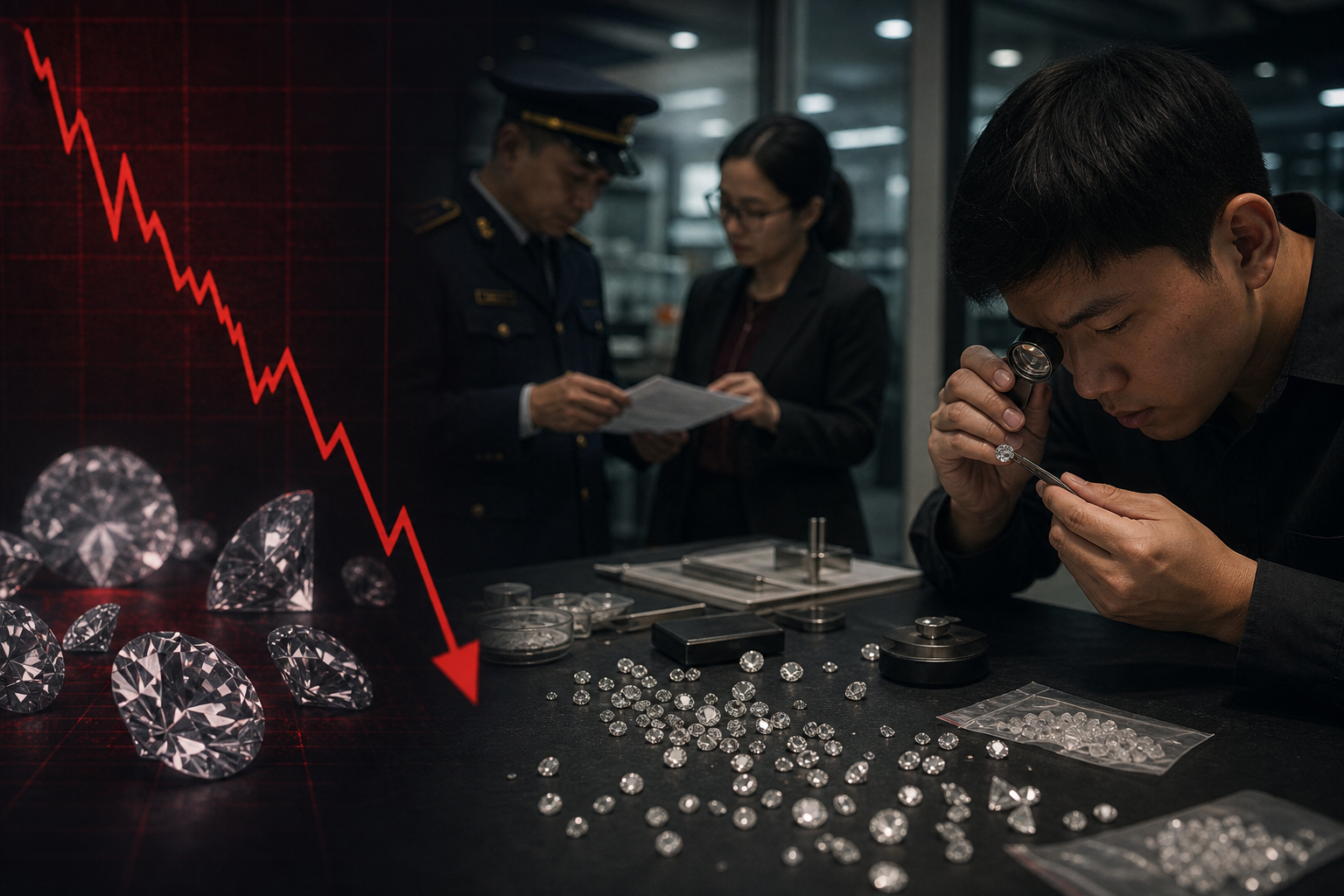
Lab-grown diamonds have shed roughly 79% of their retail value since early 2020, with an average one-carat round stone now selling for around $768, according to data cited by the Financial Times. In Vietnam, that structural price collapse has collided with a criminal fraud case that has rattled confidence across the entire gemstone market.
The P-Lab Scandal Spreads Beyond Natural Diamonds
On 2 July 2026, investigators announced the prosecution of Đặng Ngọc Thảo, the former director of P-Lab, as part of a cross-border diamond smuggling investigation. Prosecutors allege that stones with specifications mismatched to their GIA certificates were acquired, had their original laser-inscribed codes ground away, received new codes, and were then recertified under P-Lab grading reports before entering the market. The investigation has since expanded to include representatives from several retail diamond outlets and a gemological employee.
The immediate fallout focused on natural diamonds, but the shockwave quickly reached the lab-grown segment. Buyers who had trusted the certified, traceable nature of synthetic stones began scrutinising every line on grading reports and every laser inscription on girdles — precisely the verification steps the P-Lab case showed could be manipulated.

Why Certification Alone No Longer Reassures Buyers
Associate Professor Nguyễn Ngọc Khôi, head of the TC174 technical committee on jewellery, argues that the problem extends well beyond a few rogue businesses and reflects structural weaknesses in Vietnam's entire gemstone market. Grading laboratories currently operate without unified licensing or oversight from a single regulatory authority, leaving consumers with almost no independent means of verification.
The market's information problem is acute: most buyers lack the equipment and expertise to assess a stone's origin, clarity, colour, or any treatments applied. A diamond purchase is effectively three simultaneous transactions — the stone itself, the certificate attached to it, and the seller's reputation. When any one of those elements is called into question, confidence in the whole system fractures.
GIA grades lab-grown stones with a "Laboratory-Grown" inscription alongside the report number on the girdle; IGI similarly distinguishes natural, lab-grown, and simulant material in its reports. But the P-Lab case surfaced a more basic concern: a verifiable certificate is only meaningful if the stone in front of the buyer actually matches it.

A Structural Price Decline Predates the Scandal
Lab-grown diamonds were already under severe price pressure before P-Lab became a household name in Vietnamese financial news. The approximately 79% retail price decline since early 2020 reflects manufacturing economics, not a temporary market correction. As production technology advances, the cost of growing a diamond in a reactor continues to fall, and that cost reduction passes quickly into retail prices. Over the same period, comparable natural diamonds fell around 24% — a meaningful drop, but far smaller in scale.
Nguyễn Công Minh, CEO of Labdiamond Việt Nam, spent months livestreaming and educating consumers on the fundamental question the lab-grown sector faces: "Is it a real diamond?" His business model rested on accessible pricing, international certification, and transparent sourcing. The P-Lab scandal now tests whether that promise holds up under heightened scrutiny.
Secondary Market Exposes Liquidity Gap
Activity in Vietnamese online gem communities reveals a market in transition. Rather than asking only about colour grades or stone size, buyers are increasingly querying seller credibility and resale terms. Questions like whether lab-grown diamonds can be sold back at minimal loss, and requests for community identity checks on individual sellers, have become common in public Facebook groups and forums.
The emergence of dedicated resale groups — with names such as "Hội Thanh lý Kim cương Nuôi cấy IGI GIA Việt Nam" — confirms that a secondary market exists. It also highlights its core weakness: stones must be moved peer-to-peer through community channels because no standardised pricing mechanism or institutional buyback infrastructure exists for lab-grown diamonds in Vietnam.
A Ho Chi Minh City jewellery trader, Cung Hậu, notes that 7mm lab-grown stones currently trade at roughly 9 million VND — far below equivalent natural diamonds — but typical resale terms still involve meaningful losses. He suggests the price gap can sustain demand for wedding and engagement rings bought for use, but the rapid depreciation curve makes lab-grown stones difficult to position as stored value.
What Buyers Should Now Demand at the Point of Sale
The combination of the P-Lab fraud case and the ongoing structural price decline has effectively raised the minimum standard for a defensible purchase. IGI or GIA grading reports, confirmed laser inscriptions, itemised receipts specifying stone type, and clearly stated exchange or buyback policies are no longer optional extras — they are the baseline conditions for a transaction that carries any degree of buyer protection.
For anyone considering a lab-grown diamond purchase in Vietnam right now, the practical guidance is straightforward: verify that the laser-inscribed code on the stone matches the report number on the certificate before any payment changes hands, buy only from sellers who provide full documentation and a written exchange policy, and treat the purchase as a consumer good rather than an asset likely to hold its value over time.