Americans lost more than $20 billion last year to "pig-butchering" investment fraud, according to FBI data, with Cambodia serving as one of the industry's primary hubs. A sweeping government crackdown, accelerated by U.S. sanctions and Chinese extraditions, has largely dismantled those operations — but it has left tens of thousands of trafficked migrant workers stranded in Phnom Penh with no money, no shelter, and no clear path home.
Scam Empire Built on Coercion
For more than half a decade, Cambodia's scam industry operated in plain sight, occupying high-rise towers overlooking the Mekong River and sprawling compounds that functioned as self-contained cities, complete with supermarkets, pharmacies, and karaoke bars. One compound visited by NPR after it was cleared could house 20,000 workers. Behind the scale was a system of systematic coercion: migrants recruited with promises of legitimate jobs were instead held against their will and forced to defraud victims online, facing physical punishment for missing quotas.
Workers interviewed by NPR from Indonesia, Uganda, Ghana, and Sierra Leone described nearly identical recruitment stories — offers of decent wages, free food, and accommodation that turned into captivity. One Ugandan man said he was promised work as a delivery driver for $850 a month before being forced into a scam compound concealed behind a casino. Another described being electrocuted for failing to meet his daily targets.
Washington Sanctions, Beijing Extradites
The crackdown gained decisive momentum in late 2024. The U.S. Treasury sanctioned Prince Holding Group, one of Cambodia's largest conglomerates, for allegedly operating industrial-scale fraud compounds. Its chairman, Chen Zhi, was indicted on charges of directing forced-labor scam operations and laundering billions in criminal proceeds. In January 2026, Chen was extradited from Cambodia to China — a striking signal that figures once considered untouchable had lost their protection.
Beijing's willingness to extradite several alleged Chinese scam kingpins from Cambodia marked a significant shift in regional enforcement dynamics. Researchers tracking these organized crime networks told NPR that the combination of police raids and the fall of powerful patrons pushed scam operations to relocate out of Cambodia entirely. The physical infrastructure they left behind — those tower floors and massive compounds — emptied quickly.
A Secondary Crisis Emerges
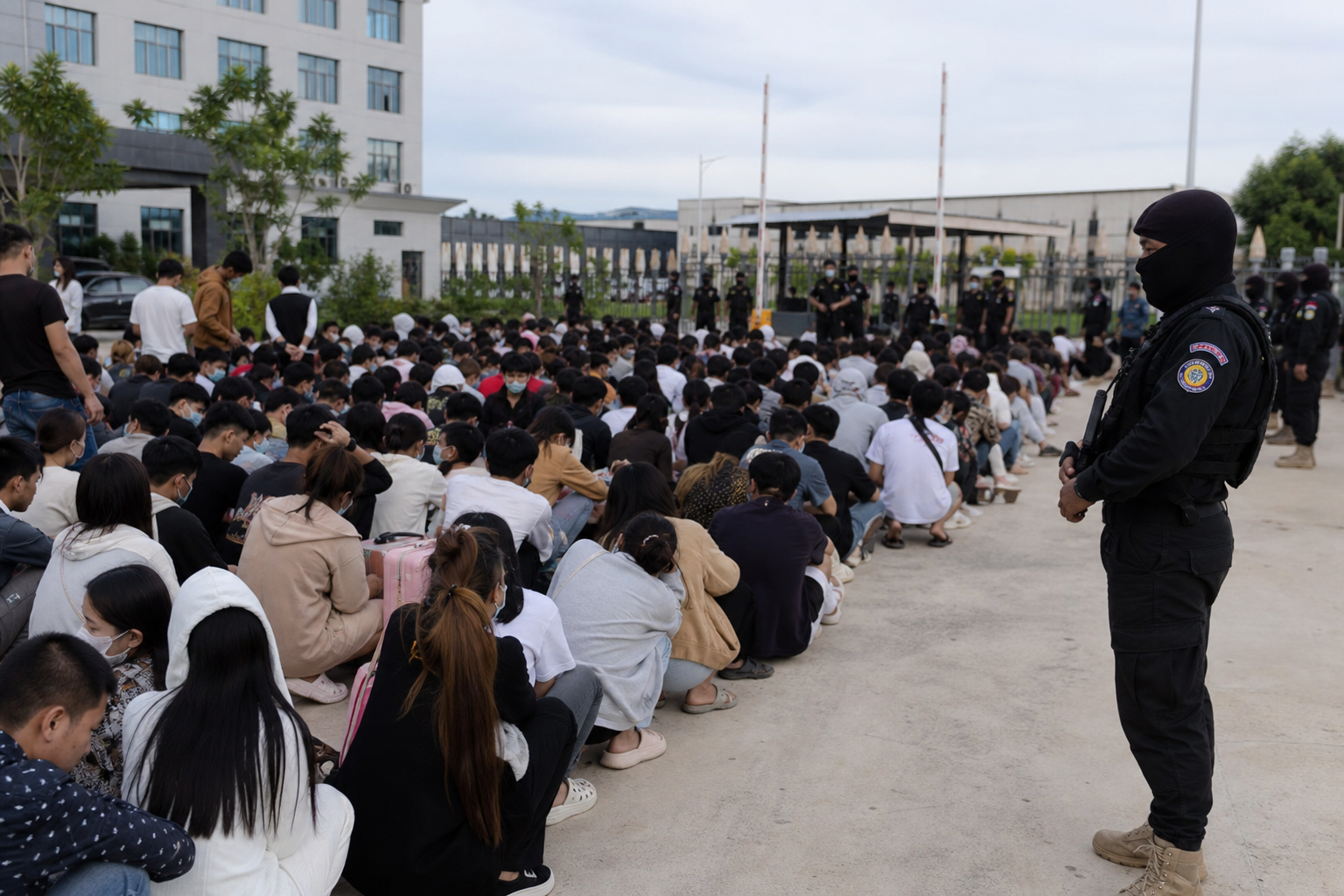
With each compound closure, thousands of migrant workers were released onto Phnom Penh's streets without money, documentation, food, or shelter. Amnesty International interviewed 73 people freed from compounds in recent months and determined that all qualified as victims of human trafficking. United Nations agencies have separately documented widespread use of forced labor and torture within the industry over several years.
The Cambodian government's response has compounded the problem rather than resolved it. Authorities have treated released workers as irregular migrants rather than trafficking victims, requiring them to pay overstay fines of $10 per day — fees that accumulate into debts of thousands of dollars for those held for months. Cambodia has only one dedicated shelter for trafficking victims in the entire country, and it is full, with a waitlist running into the hundreds.
In recent weeks, authorities have intensified detention of migrants on visa violation grounds, placing them in overcrowded immigration facilities without legal representation. Embassies from affected countries are negotiating with Phnom Penh to waive the fines, but progress has been slow while workers remain in legal limbo.
Half a Solution
Mark Taylor, a human trafficking consultant who previously led a USAID-backed program in Cambodia, told NPR that the government "has only addressed half of this problem" — dismantling the scam operations while ignoring the tens of thousands of vulnerable migrants those operations drew in and now leave exposed to re-trafficking.
The concern is structural. Scam networks actively target economically desperate workers across Southeast Asia and sub-Saharan Africa, using the same recruitment infrastructure that filled the compounds in the first place. Without repatriation support, legal protection, and sustained international pressure on Cambodia to treat freed workers as victims rather than violators, that same population remains vulnerable to being recruited again by operations that have simply moved across a border.
Regional Displacement Risk
Researchers tracking the scam industry note that operations have already been relocating — to Myanmar's border zones, Laos, and elsewhere in Southeast Asia — as Cambodia tightened enforcement. The humanitarian failure in Phnom Penh matters beyond its immediate context: if survivors are detained, fined, or left destitute rather than repatriated and supported, it signals to other governments in the region that crackdowns can be conducted without the costly obligations of victim protection. That precedent could shape how Myanmar, Laos, and others handle similar pressure when it eventually arrives.
For aid organizations and governments working to dismantle the broader scam economy, the lesson from Cambodia is that enforcement without aftercare creates its own crisis — one that sustains the very vulnerability the criminal networks depend on.