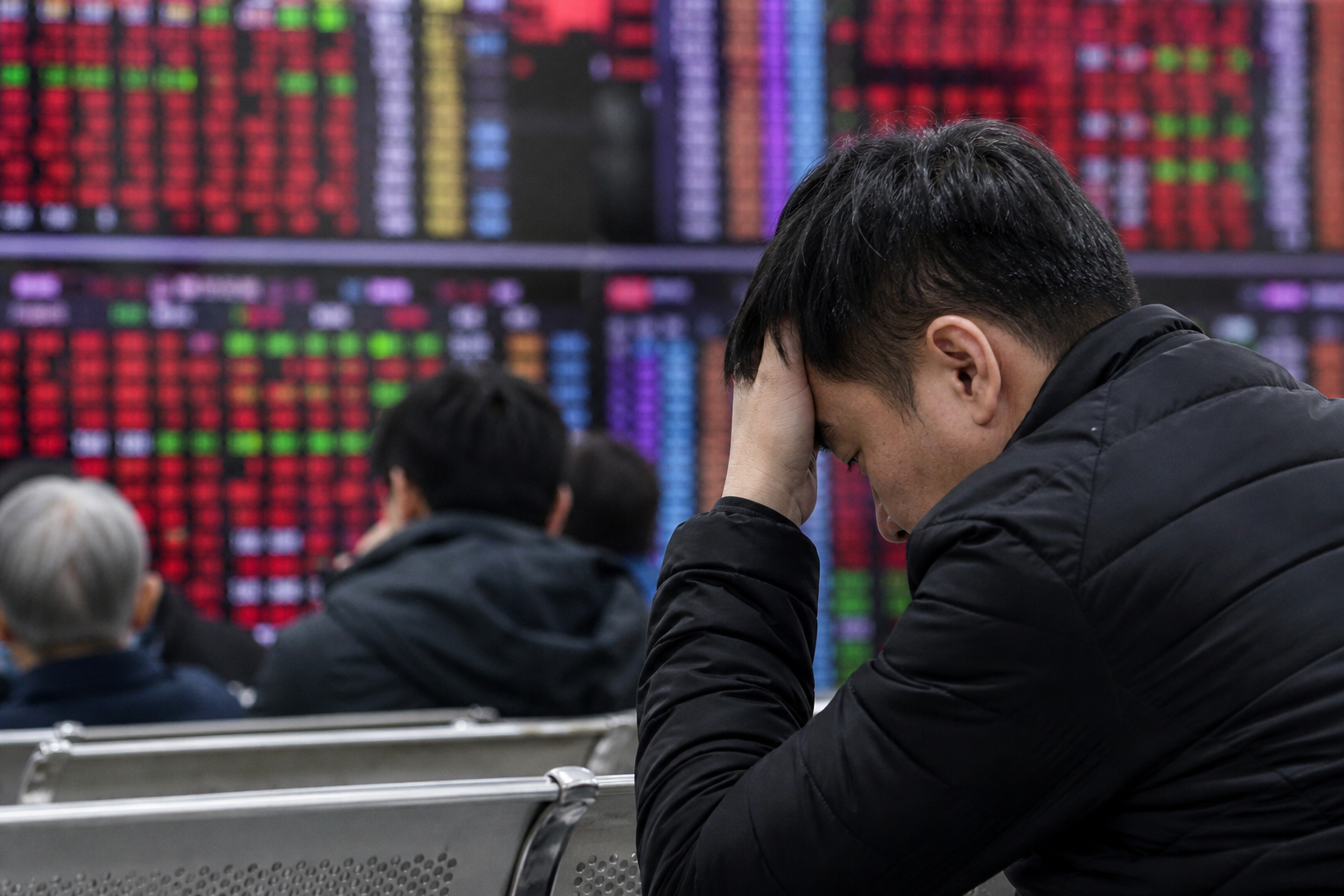
Vietnam's benchmark equity index shed more than 62 points on Wednesday, closing at 1,668 — its lowest level in four months and the steepest single-session decline since a record 115-point crash earlier this year. The selloff has now erased 13.5% from the all-time high of 1,927 set just two months ago, with analysts warning the index could fall a further 4-5% before finding a floor.
Margin Calls Cascade Across the Board
The immediate trigger was a sharp escalation in forced selling, according to Tyler Nguyen Manh Dung, head of market strategy research at HSC Securities. Sell orders concentrated in two windows — 10:30–11:00 a.m. and 2:00–2:30 p.m. — the standard time slots brokerages use to execute margin-safety procedures. Individual order sizes were not unusually large, but each wave of selling dragged prices lower, triggering further calls and creating a self-reinforcing loop.
HSC's Dung described a phenomenon of "cross-margin liquidation," where stocks hitting floor prices prompted brokerages to cut lending ratios, forcing investors to sell liquid holdings elsewhere to top up collateral. This spread pressure from speculative small-caps into large-cap names that had no negative company-specific news on the day.

Record Margin Debt Amplifies the Drop
The structural backdrop made the situation fragile. Margin lending across Vietnamese brokerages reached an all-time high of approximately VND 450 trillion at the end of Q2 — a figure that spooked investors even before Wednesday's session. Truong Quang Vinh, branch director at ACB Securities in Ho Chi Minh City, noted that many retail investors chose to pre-emptively reduce exposure and cut losses rather than wait for margin calls to be issued automatically.
High interest rates compounded the pressure. With benchmark rates still elevated, the cost of carrying leveraged positions is significant, and would-be buyers were unwilling to step in and absorb selling — a dynamic traders refer to as catching a falling knife.

Vingroup Stocks Wipe Out Half the Index's Loss
The selloff took on a particularly sharp character because it finally reached Vingroup, the conglomerate whose two flagship listed vehicles — VIC and VHM — had been acting as a buffer against broader market weakness throughout the prior week's decline. On Wednesday, both stocks faced heavy selling simultaneously, accounting for roughly 32 of the session's 62-point loss, or about half the index's decline. Vinh described the preceding week as a gradual rotation out of banking, securities, oil and gas, and steel stocks, with Vingroup providing temporary support that ultimately gave way.
Foreigners Pull Nearly VND 5 Trillion
Overseas investors added meaningful selling pressure on top of domestic margin dynamics. Foreign funds net-sold close to VND 5 trillion during the session — the heaviest outflow in roughly six weeks — targeting blue-chip financial names including SSI, ACB, EIB, TPB, and VIB. Both analysts flagged resident foreign funds, those with a permanent operational presence in Vietnam, as particularly active in the withdrawal. Total matched turnover on the Ho Chi Minh Stock Exchange came to around VND 23 trillion, only marginally above the prior session, suggesting buyers largely stayed on the sidelines rather than filling the gap left by foreign selling.

Where Analysts See Support
Near-term forecasts from multiple brokerages point lower before any stabilization. An Binh Securities (ABS) put a downside target of 1,606 in its evening note, while Tien Phong Securities (TPS) identified the 1,580–1,600 band — the zone that formed a bottom in March — as the next meaningful support level. That implies an additional 4-5% decline from Wednesday's close.
Vinh said two market signals would indicate that selling pressure has genuinely exhausted itself: high-volume sessions where the price decline narrows, and balanced market breadth where advancing and declining stocks are roughly equal rather than lopsided. Without both conditions appearing together, any index rebound driven by a handful of heavyweight stocks could be misleading.
Macro Fundamentals Still Intact, Analysts Say
Despite the severity of the move, HSC's Dung drew a clear distinction between technical and fundamental deterioration. "VN-Index is correcting due to psychological and technical factors rather than weakening macro foundations or corporate earnings prospects," he said. He pointed to liquidity trends and profit outlook as the two variables worth monitoring most closely: improving turnover would signal that fresh capital is ready to absorb remaining sell orders, while stable earnings visibility at growth-oriented companies should provide a price anchor over a longer horizon.
Investor Takeaway
For investors with exposure to Vietnamese equities, the current episode illustrates the outsized role margin debt plays in amplifying corrections in this market. With VND 450 trillion in outstanding margin loans, any sustained price weakness can trigger reflexive selling that overshoots fundamental value. The 1,580–1,600 support range identified by TPS corresponds to proven demand from earlier this year and represents a level where risk-reward may shift, though the two stabilization signals — narrowing decline on high volume and broad market balance — have not yet appeared. Monitoring daily foreign flow data and brokerage margin ratios will be more informative than index levels alone in gauging when the flush is complete.