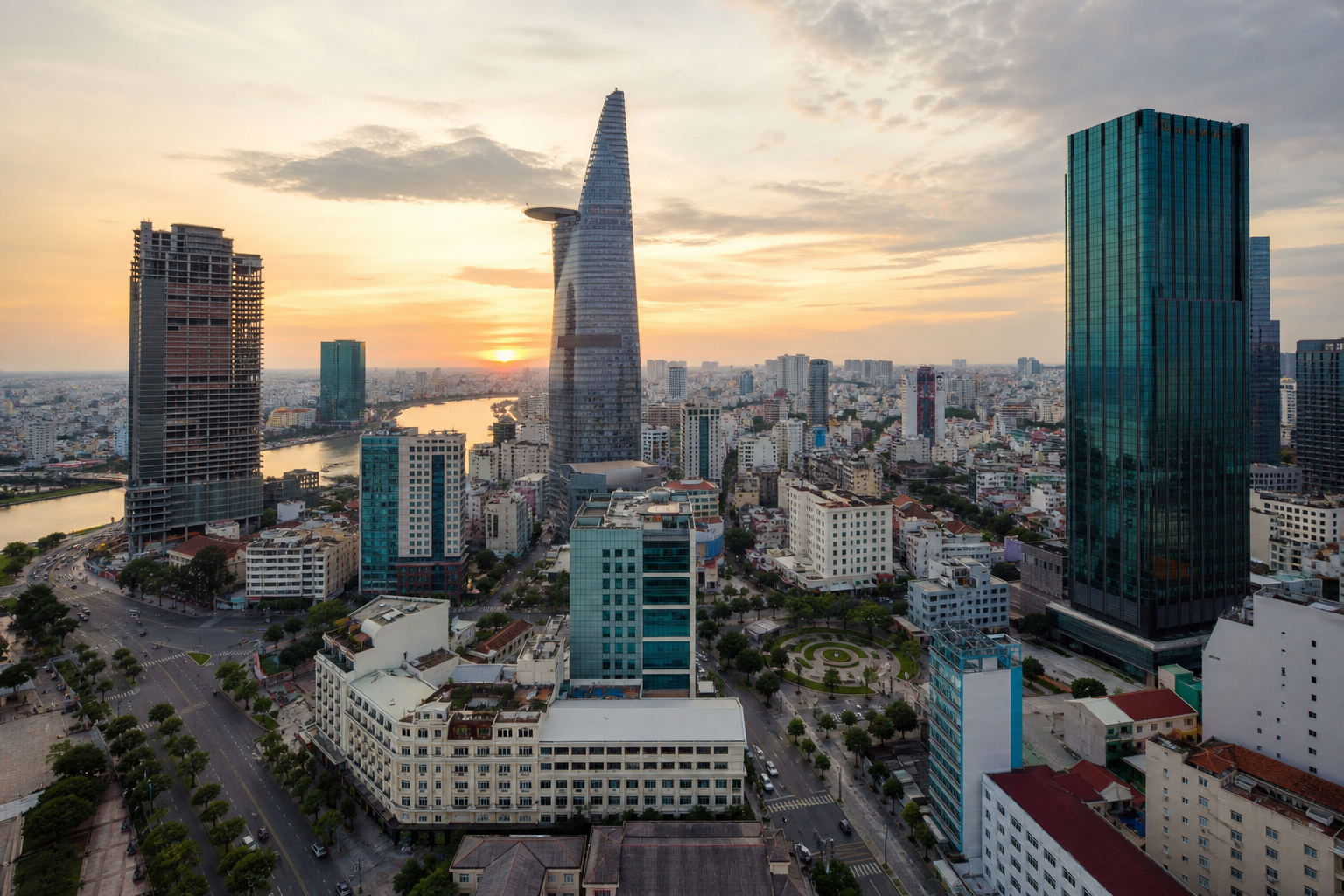
Vietnam has approved a formal development plan targeting international financial centre status for both Ho Chi Minh City and Da Nang, with a deadline of 2035. The plan sets a concrete ranking goal: third place in ASEAN and top 25 in the Asia-Pacific region on the Global Financial Centres Index (GFCI) or an equivalent benchmark, placing the two cities among the world's top 75 financial hubs.
A First Set of Quantified Targets
Previous Vietnamese financial centre ambitions remained largely aspirational, but this plan marks the first time Hanoi has attached specific, measurable rankings to the initiative. Deputy Prime Minister Nguyen Van Thang, who chairs the International Financial Centre Steering Council, signed the decision approving the roadmap to 2035. The use of the GFCI as an anchor metric matters because it is the same index that global financial institutions and asset managers consult when making location decisions — putting Vietnam's ambitions in the same frame as Singapore, Hong Kong, and Kuala Lumpur.
Two Cities, Two Distinct Roles
Rather than duplicating effort, the plan assigns each city a differentiated mandate. Ho Chi Minh City is designated as the full-spectrum financial hub, covering capital markets, asset management, fund management, green finance, digital finance, and commodity and derivatives markets tied to trade and international logistics. Da Nang takes the fintech and innovation lane, concentrating on digital assets, digital payments, asset tokenisation, specialised trading platforms, and a regulatory sandbox for new financial products and business models. This division of labour reduces internal competition between the two sites and, in theory, allows each to build a more distinctive identity for foreign firms evaluating Southeast Asian bases.

The 2026–2030 Foundation Phase
The decade-long roadmap is split into phases. The first, running through 2030, focuses on building the institutional plumbing: a bespoke legal framework that meets international standards, governance structures with clear lines of accountability, and parallel investment in financial infrastructure, digital infrastructure, and data infrastructure. The plan also calls for streamlined administrative procedures — digitised licensing, shorter processing times, and improved public services — that foreign financial institutions routinely cite as friction points in emerging markets. Pilot operations for priority financial products are scheduled to begin during this same window.
Legal Architecture as the Core Challenge
The plan explicitly calls for a dispute resolution mechanism with internationally recognised and enforceable judgments. That single clause signals awareness of the most fundamental obstacle: sophisticated cross-border capital will not flow into a jurisdiction where contract enforcement is uncertain. Vietnam's existing civil court system is slow and lacks the common-law predictability that global banks, funds, and insurers expect. Whether Hanoi opts for a dedicated financial court, an international arbitration framework, or a hybrid model will be a key signal of ambition versus aspiration. The plan also promises competitive incentive packages — tax, regulatory, and operational — to attract anchor institutions such as major banks, investment funds, and high-calibre talent, which are the network effects that determine whether a financial centre gains critical mass.
Where Vietnam Sits Today
Vietnam does not currently appear in the top tier of the GFCI rankings, meaning the gap to close before 2035 is substantial. Singapore holds the dominant regional position, and Kuala Lumpur and Bangkok have years of head-start in regulatory infrastructure. The ASEAN third-place target is therefore aggressive but not implausible over a decade, particularly if Vietnam can translate its strong FDI manufacturing base and rapidly growing domestic capital market into genuine financial services depth. Vietnam's stock market capitalisation and bond market remain underdeveloped relative to GDP compared to regional peers, which is simultaneously a challenge and an upside argument for the plan.

Investor Takeaway
For global investors, the plan is a directional signal rather than an immediate opportunity. The 2026–2030 phase will determine credibility: watch for concrete legislation establishing the bespoke legal framework, the first international arbitration or financial court arrangements, and which anchor institutions — if any — commit to HCMC or Da Nang operations. If the institutional framework firms up on schedule, the plan could accelerate Vietnam's capital market upgrade, making it more accessible to foreign portfolio investors and creating new channels for deal flow in asset management, green finance, and digital assets. The Da Nang fintech sandbox, in particular, deserves attention from firms operating in the digital asset space across the Mekong region.