Ho Chi Minh City is accelerating its urban rail ambitions, and for the first time a domestic technology enterprise is taking a formal role in the network's core systems. On July 17, GTEL — the Global Technology and Telecommunications Corporation under Vietnam's Ministry of Public Security — signed a cooperation agreement with the city's Urban Railway Management Authority (MAUR), committing to research, integrate, and transfer the operational technology that underpins metro infrastructure.
A City Racing Toward 200 km
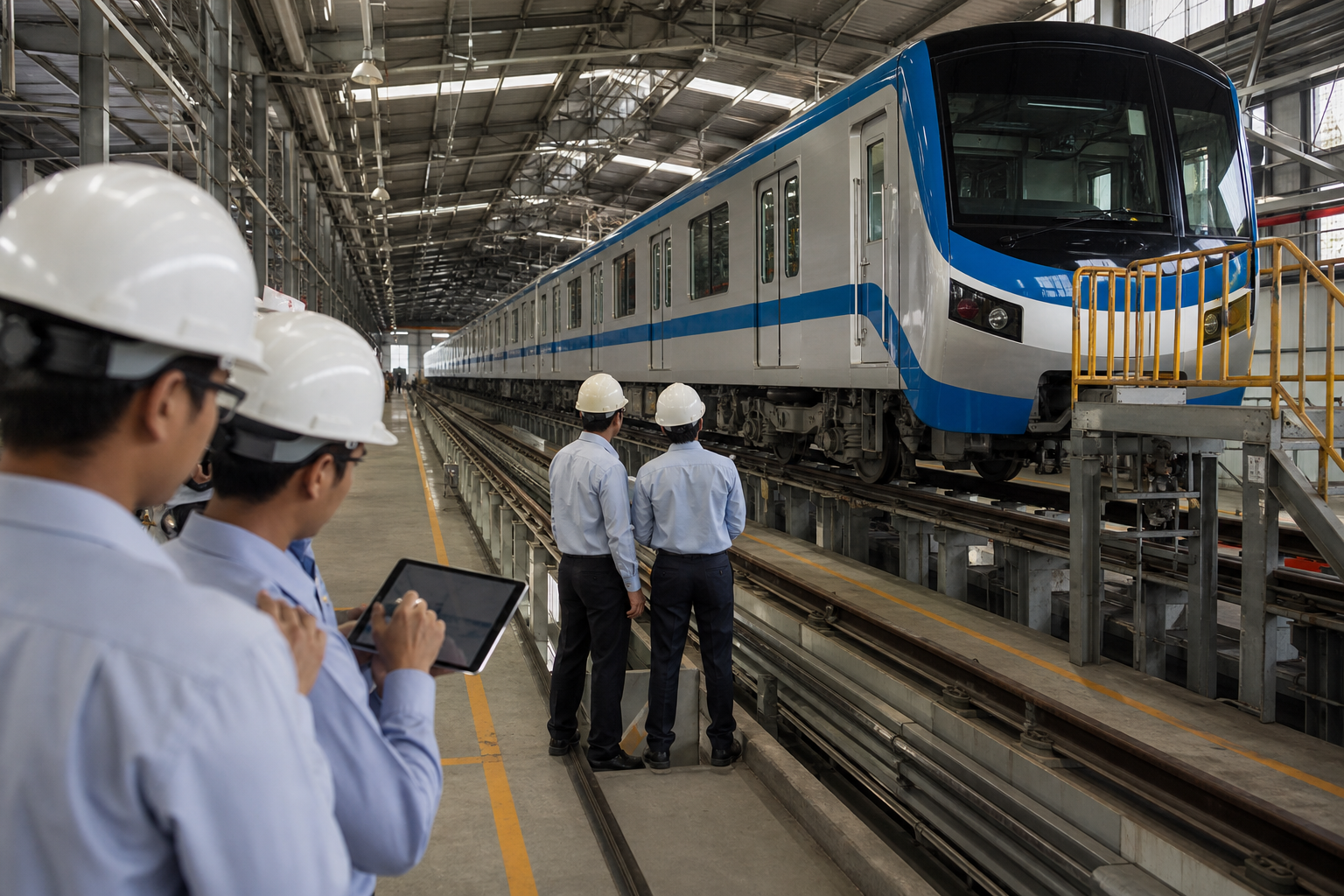
Ho Chi Minh City currently operates just under 20 km of metro on Line 1, the Bến Thành – Suối Tiên corridor, which opened after years of delays and cost overruns. The gap between that figure and the city's 200 km target for 2030 is stark: seven additional lines must reach completion within five years. After recent administrative boundary expansions, the long-term metropolitan rail plan has been revised upward to more than 1,000 km — making technology sovereignty and cost control existential concerns, not aspirational ones.
What GTEL Brings to the Table
Founded in 2007 and now reporting directly to the Ministry of Public Security, GTEL operates across digital technology, cybersecurity, and telecommunications. Its involvement in metro is not cosmetic. Under the MAUR agreement, the corporation will focus on the electrical and mechanical systems (E&M), SCADA control platforms, operations control centres (OCC), and automatic fare collection (AFC) — the technical backbone that foreign vendors have historically supplied under turnkey contracts. The initial deployment will target the Bến Thành – Tham Lương line and a cluster of other projects scheduled between 2026 and 2030.
Localisation as a Strategic Imperative
Ho Chi Minh City's deputy chairman Hoàng Nguyên Dinh framed the agreement in explicitly strategic terms: raising the domestic technology content of metro projects reduces capital dependence on overseas suppliers, lowers lifecycle costs, and protects what he described as critical national infrastructure. The cybersecurity dimension is pointed — GTEL's parent ministry oversees national cybersecurity, and integrating its arm into metro OCC and SCADA design is a deliberate choice to keep sensitive network data within state-controlled systems. Colonel Lương Đức Minh, GTEL's chairman, said the two sides would "research, integrate systems and receive and transfer technology" to progressively master metro operations domestically.
Advanced Tech Layer: AI, Digital Twin, and IoT
Beyond legacy E&M systems, the partnership targets a forward-looking technology stack. GTEL and MAUR plan to apply AI, Digital Twin modelling, BIM, GIS, IoT, and Big Data analytics to metro management and maintenance. The end goal is a unified integrated operations centre for the entire Ho Chi Minh City rail network — an architecture that, if realised, would let city operators monitor, adjust, and maintain multiple lines from a single platform. Electronic identity (eID) integration is also on the agenda, potentially enabling seamless interoperability between metro ticketing and broader digital public services.

Building the Human Capital Pipeline
The agreement explicitly commits both parties to workforce development alongside technology transfer — a recognition that hardware and software alone cannot sustain a 1,000 km network without trained domestic engineers. This mirrors strategies seen in other emerging-market metro expansions, where local content rules forced knowledge transfer that eventually allowed cities to reduce foreign contractor dependence in subsequent phases. Ho Chi Minh City is attempting to compress that learning curve by embedding a domestic tech partner from the planning stage rather than after construction.

Investor Takeaway
For infrastructure investors and foreign technology vendors already engaged in Vietnam's metro pipeline, GTEL's entry signals a policy shift worth tracking. The city is moving to insert domestic players into systems integration and operations technology — roles that global firms from France, Japan, and South Korea have traditionally dominated. Contracts for the 2026-2030 metro tranche are likely to carry higher local-content requirements, reshaping the competitive landscape for subsystem suppliers. Meanwhile, the scale of the buildout — seven lines in five years against a long-term 1,000 km vision — keeps Vietnam's urban rail market among the most active in Southeast Asia, even as procurement terms evolve.