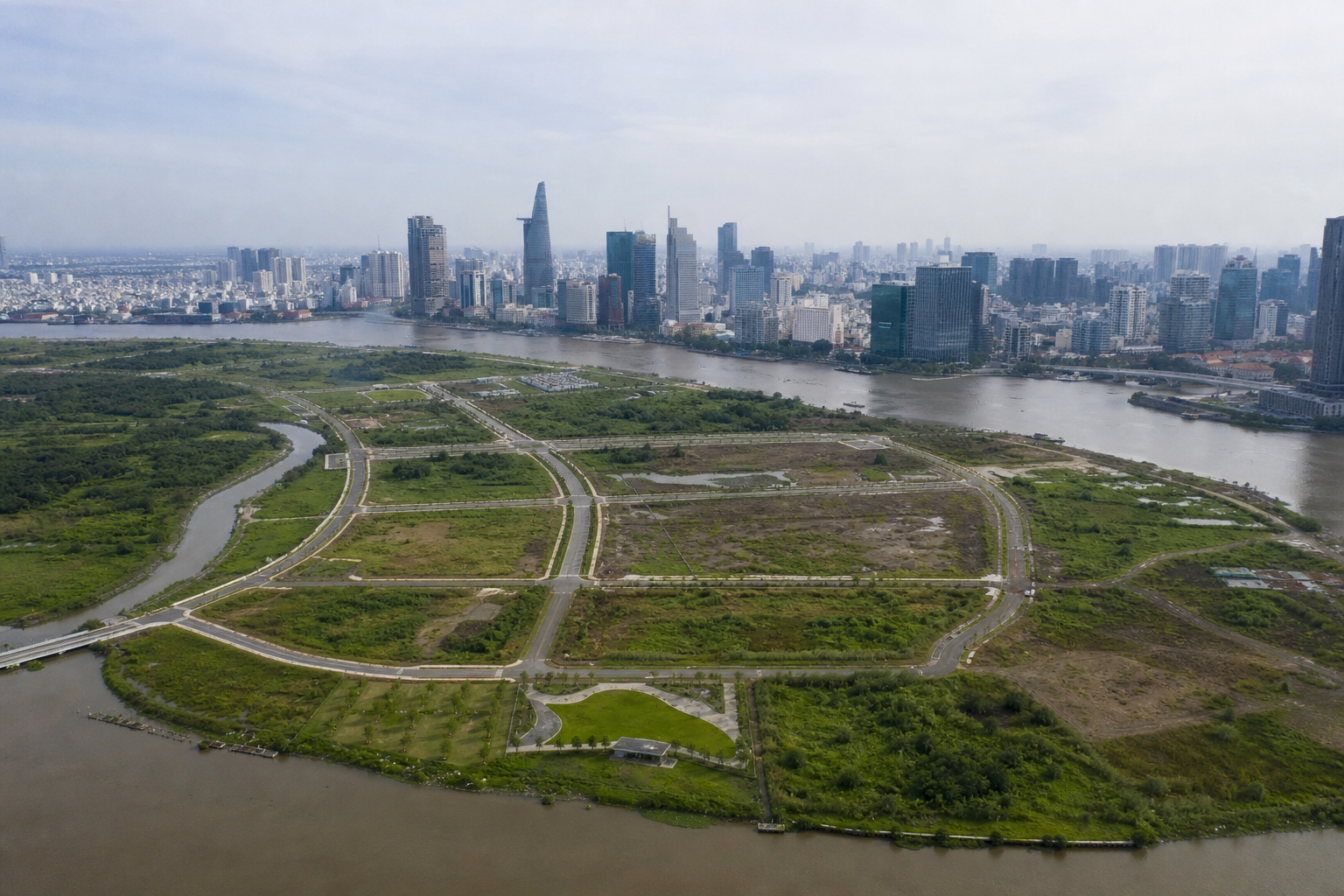
The Lotte Eco Smart City Thủ Thiêm project has completed its land-use fee obligations, paying VND 17,569 billion (roughly $680 million) to Ho Chi Minh City authorities on July 31. The payment, confirmed by listed developer Phat Dat (PDR), removes the primary legal hurdle standing between the joint venture and full construction mobilisation on a site that carries a total projected investment of VND 60,000 billion.
A Milestone Payment, Not the Full Bill
The land-use fee settlement is distinct from the broader capital commitment. Ho Chi Minh City's People's Committee approved a site-specific land valuation of VND 16,190 billion in June 2025, providing the legal basis for the fee calculation. The final amount paid — VND 17,569 billion — exceeded that approved valuation, likely reflecting accrued charges and surcharges. Completing this step gives the joint venture the land-use rights certificate needed to proceed with permitting and construction contracts.

What Is Being Built
The project sits on plot 2A of the Thu Thiem New Urban Area, now administered under An Khanh Ward, covering approximately 7.54 hectares across six sub-lots (2-1 through 2-6). The master plan calls for a multi-function urban complex combining Grade-A office towers, retail and commercial podiums, hospitality, services, and public open space. The scale places it among the largest single mixed-use schemes in southern Vietnam by investment value.
Roles Inside the Joint Venture
Lotte Properties HCMC, the project developer and majority partner, brings the Korean conglomerate's experience structuring large commercial-urban complexes internationally. Phat Dat holds a 35% stake and is contributing more than VND 10,000 billion. Under the cooperation agreement, Phat Dat co-develops the residential components in blocks 2-2, 2-4, and 2-6, while also leading development of the two commercial towers in blocks 2-1 and 2-3, plus the four-floor commercial podium and basement levels. The structure effectively gives Lotte control of the commercial and hospitality positioning while Phat Dat deploys its domestic residential sales and delivery capabilities.
Thu Thiem's Trajectory
The payment lands at a moment when Thu Thiem is being repositioned as Ho Chi Minh City's new financial, commercial, and services hub. The area's appeal rests on its adjacency to the existing central business district, its riverfront land bank, and improving transport links including metro and bridge connections. Several large-scale projects are competing for the same occupier and retail base, meaning execution speed will matter as much as the physical product.

Supply Implications for the Office and Retail Market
When delivered, Lotte Eco Smart City would add meaningful Grade-A office and premium retail supply to a city where quality stock remains constrained relative to regional peers. The addition of hospitality and serviced-residence components also addresses a gap in integrated live-work-stay product in the eastern corridor. For existing landlords in the district, the project represents future competition; for occupiers currently sitting on waitlists for Grade-A space, it represents a credible medium-term option.
Investor Takeaway
For investors watching Vietnam's real estate and FDI pipeline, the VND 17,569 billion payment is a concrete signal that large Korean capital commitments in Ho Chi Minh City are moving from announcement to execution. Phat Dat's listed status on HoSE means the joint venture's progress — and any delays — will be visible through quarterly disclosures. The next material milestone to watch is the issuance of a construction permit for the first phase, which would confirm that legal clearance has translated into ground-level activity.