Vietnam's Ministry of Justice has put forward a proposal to establish special economic zones (SEZs) at strategic coastal locations, introducing for the first time a formal legal definition of the category. The draft Urban Development Law — previously called the Special Urban Areas Law — identifies these zones as a potential engine for regional and national growth, backed by preferential governance and investment mechanisms.
A New Legal Framework
Current Vietnamese law does not recognise special economic zones as a distinct category. The Investment Law of 2025 defines only a general "economic zone" concept — a delimited area containing multiple functional sub-zones designed to attract capital and support national defence. The draft law would go further, creating an SEZ tier that sits as an administrative unit under provincial-level government, with the central government empowered to establish each zone following consultation with the National Assembly Standing Committee.
Two Criteria Tracks
The Ministry of Justice has presented two options for recognition thresholds. The first option sets concrete benchmarks: the zone must already be a coastal economic zone established by the Prime Minister, cover at least 500 km², hold a population of no fewer than 50,000 people, possess a Class I seaport or international airport, and function as a relatively self-contained, controllable space designated as a strategic growth pole. The second option delegates the specific criteria entirely to the government by decree, offering more flexibility but less predictability for investors. The final choice between the two approaches will shape how many existing zones qualify and how quickly new ones can be designated.
Underperformance Driving Reform
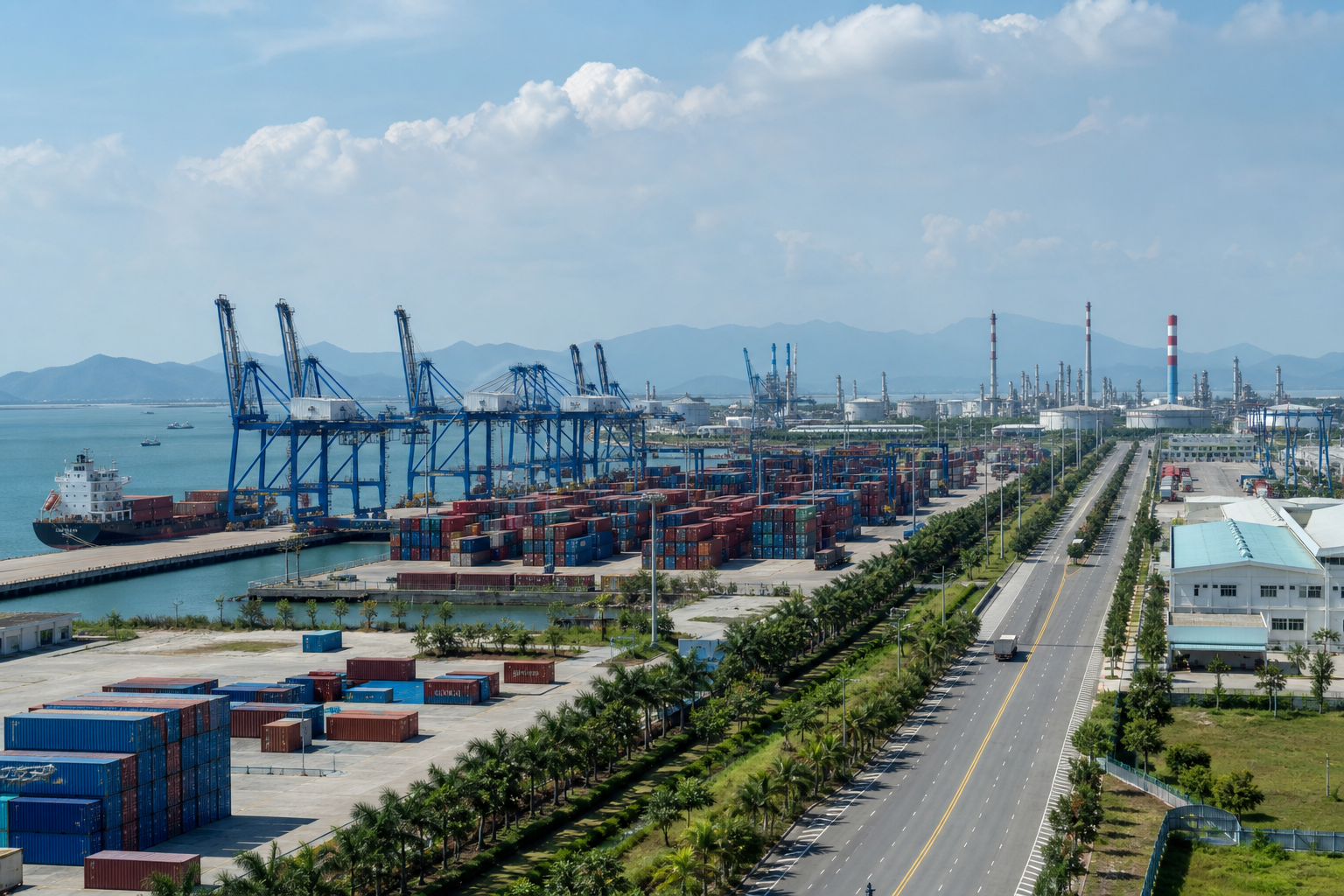
The proposal is a direct response to the disappointing track record of Vietnam's existing coastal zones. The country currently operates 46 economic zones, including 20 coastal ones covering roughly 900,000 hectares. Many have Class I or special-class port infrastructure — Nghi Son, Dung Quat, Van Phong, Vung Ang — or international airports such as Van Don, Chu Lai, and Phu Quoc. Despite these natural and physical advantages, fill rates remain low, land available for lease is limited, and infrastructure is patchy. Large-scale zones including Van Don, Van Phong, Nghi Son, and Dong Nam Nghe An have developed more slowly than their footprint and location would suggest. The ministry's diagnosis is blunt: physical assets alone cannot compensate for institutional gaps.
Governance Design
The draft envisions a tailored administrative structure for each SEZ. The zone's People's Committee chairman would gain authority over the recruitment and management of civil servants and employees within the zone — a meaningful departure from standard provincial personnel rules. The number of vice-chairmen permitted would also exceed current statutory limits, allowing for a more specialised leadership structure. Customs inspection and supervision would be consolidated under a single dedicated unit, with the General Department of Customs empowered to create new sub-units if operational needs require it. These governance provisions signal an intent to reduce bureaucratic friction rather than simply redraw maps.
Global Context
The Ministry of Justice frames the proposal against a broad international backdrop. Roughly 7,000 SEZs operate across more than 140 countries, functioning as what the ministry calls "policy laboratories" where states pilot new institutional arrangements and test the competitiveness of their investment climates before rolling changes out nationwide. Vietnam's 13 existing special districts show a wide development gap: zones with strong connectivity and investor familiarity — Phu Quoc, Van Don, Cat Hai — have outpaced smaller, more isolated districts still reliant on subsistence economies. The ministry concludes that infrastructure quality, institutional design, and regional linkages are the decisive variables, not geography alone.
Investor Takeaway
For investors tracking Vietnam's long-term FDI landscape, the SEZ proposal is a structural signal worth monitoring. If the draft law passes with Option 1's criteria intact, a handful of well-positioned coastal zones — those already holding Class I port or airport status — would become eligible for a governance upgrade that could materially improve the speed and cost of doing business there. The combination of streamlined customs, expanded administrative authority, and an explicit "strategic growth pole" mandate could attract the large-scale anchor investors that have so far bypassed underperforming zones. The law's progress through consultation and eventual parliamentary approval will determine how quickly that potential converts into deployable opportunity.