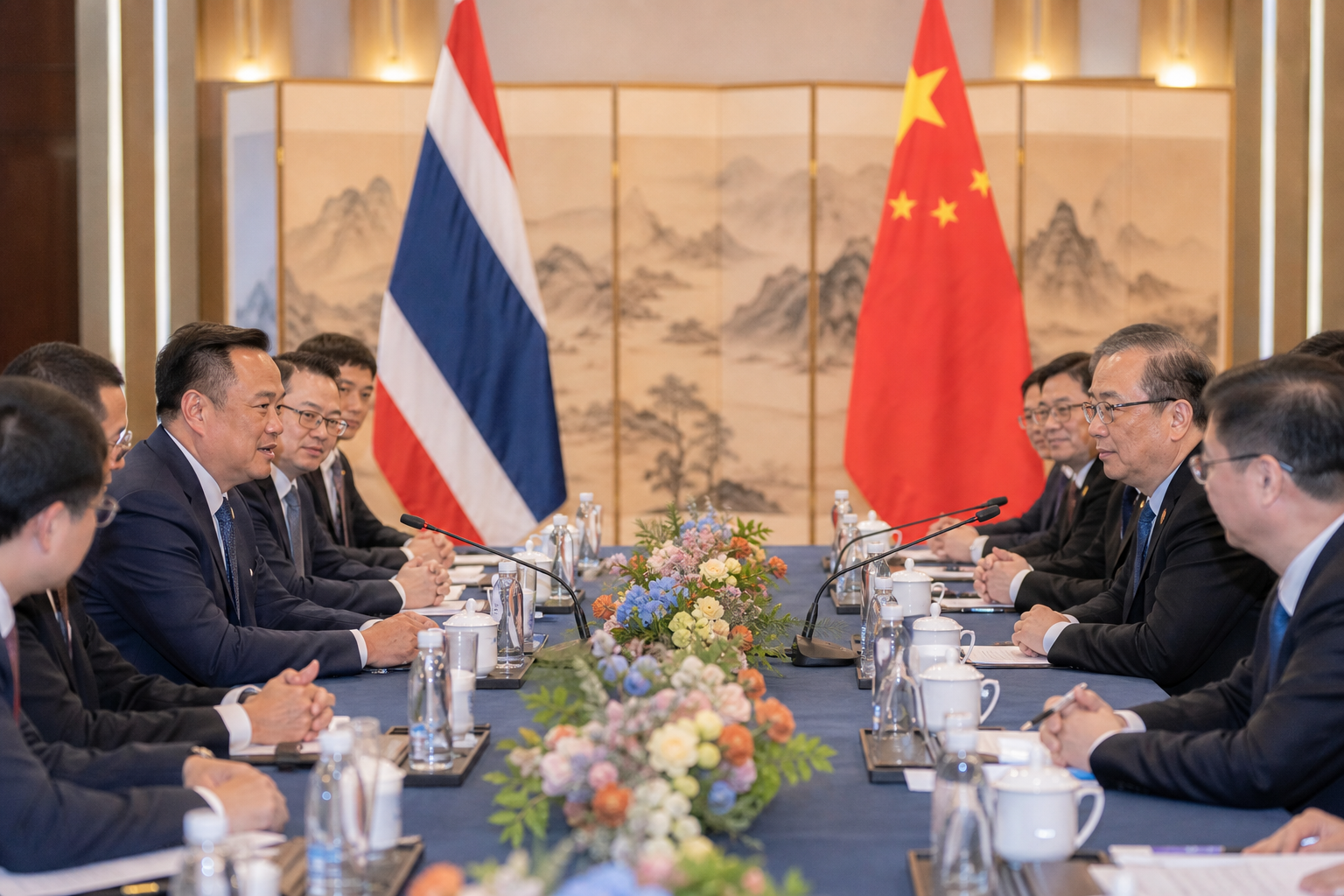
Thailand's Prime Minister Anutin Charnvirakul departs this week on a five-day visit to Beijing and Shanghai, seeking to deepen economic ties with China and pull in capital for semiconductors, artificial intelligence, and electric vehicles. The trip runs July 16–20 and follows a first-quarter FDI reading in which Thailand approved 427 projects worth 965 billion baht, though China ranked fourth as a source country with just 17 billion baht — well behind Singapore's dominant 837 billion baht.
Investment Roadshow Mechanics
Industry Minister Varawut Silpa-archa described the China leg as a deliberate investment roadshow rather than a diplomatic courtesy call. The government is rolling out the Thailand Fast Pass programme alongside the visit, a facilitation scheme designed to strip bureaucratic delays from the approval pipeline. Officials say the goal is to create a direct path from investor interest to signed project agreements, with the expectation that faster processing will translate into higher headline FDI numbers through the remainder of 2025.
Semiconductor Push Sets Long-Horizon Targets
Prior to the trip, Anutin signed an order creating the National Semiconductor and Advanced Electronics Policy Committee, a body intended to coordinate policy across ministries. Thailand's semiconductor ambitions are unusually specific: attract 2.5 trillion baht in investment, train more than 230,000 skilled workers, and bring domestically made chips to market by 2050. The 25-year timeline reflects how far upstream Thailand sits in the current global semiconductor supply chain, but the targets also signal genuine policy commitment rather than aspirational rhetoric.
AI and Data Centre Linkage
Finance Minister Ekniti Nitithanprapas connected the technology investment drive to a parallel data centre build-out. His argument is straightforward: without local data infrastructure, cloud services cannot scale, and without cloud capacity, AI applications lack the compute backbone to develop commercially. Thailand has been positioning itself as a Southeast Asian data centre destination, and locking in Chinese technology partners during the Beijing and Shanghai meetings could accelerate site commitments from firms already familiar with large-scale infrastructure deployment.
Electric Vehicles and the 30@30 Policy
The automotive sector offers a more near-term commercial hook for Chinese investors. Under the government's "30@30" target, EVs must represent 30% of Thailand's total vehicle production by 2030 — a goal that requires 725,000 zero-emission cars, 675,000 electric motorcycles, and 34,000 electric buses and trucks to roll off domestic production lines within five years. Chinese automakers and battery suppliers are already among the most active players in Thailand's EV ecosystem, making this segment a natural focal point for deal conversations in Shanghai, home to several of China's largest electric vehicle manufacturers.
China's FDI Position Versus Its Trade Weight
The gap between China's trade significance and its current FDI ranking in Thailand is one of the more telling data points from the Q1 figures. China has historically concentrated its outbound investment in clean energy, smart electronics, and digital industries — all categories Thailand is now actively courting — yet Singapore claimed nearly 87% of total approved FDI value in the first quarter. Some of that Singapore-domiciled capital originates elsewhere, but the disparity suggests either that Chinese firms are routing investment through third-party holding structures or that Bangkok sees real room to grow direct Chinese project commitments through high-level diplomatic engagement like this week's visit.
Investor Takeaway
For investors tracking Southeast Asian technology and manufacturing flows, this visit is worth watching as a signal of where Thai policy attention is concentrating. A credible fast-track approval mechanism combined with explicit semiconductor and EV targets gives Chinese firms clearer incentives to shift from trade relationships to equity-backed production in Thailand. Whether the 2.5 trillion baht semiconductor figure ever materialises is secondary — the policy architecture being built around it is real, and it shapes the competitive landscape for any company considering where in the region to anchor the next generation of advanced manufacturing capacity.