A Decade-Long Delay, a Mounting Bill
Vietnam's most ambitious urban flood-control project is bleeding money at a rate of roughly VND 1.08 billion per day — about VND 388 billion a year. As of end-June 2025, total accrued loan interest on Ho Chi Minh City's tidal-surge barrier project has exceeded VND 2,535 billion, equivalent to roughly USD 100 million, according to the project's developer, Trung Nam An Trieu, a subsidiary of Trung Nam Group.
What the Project Is Supposed to Do
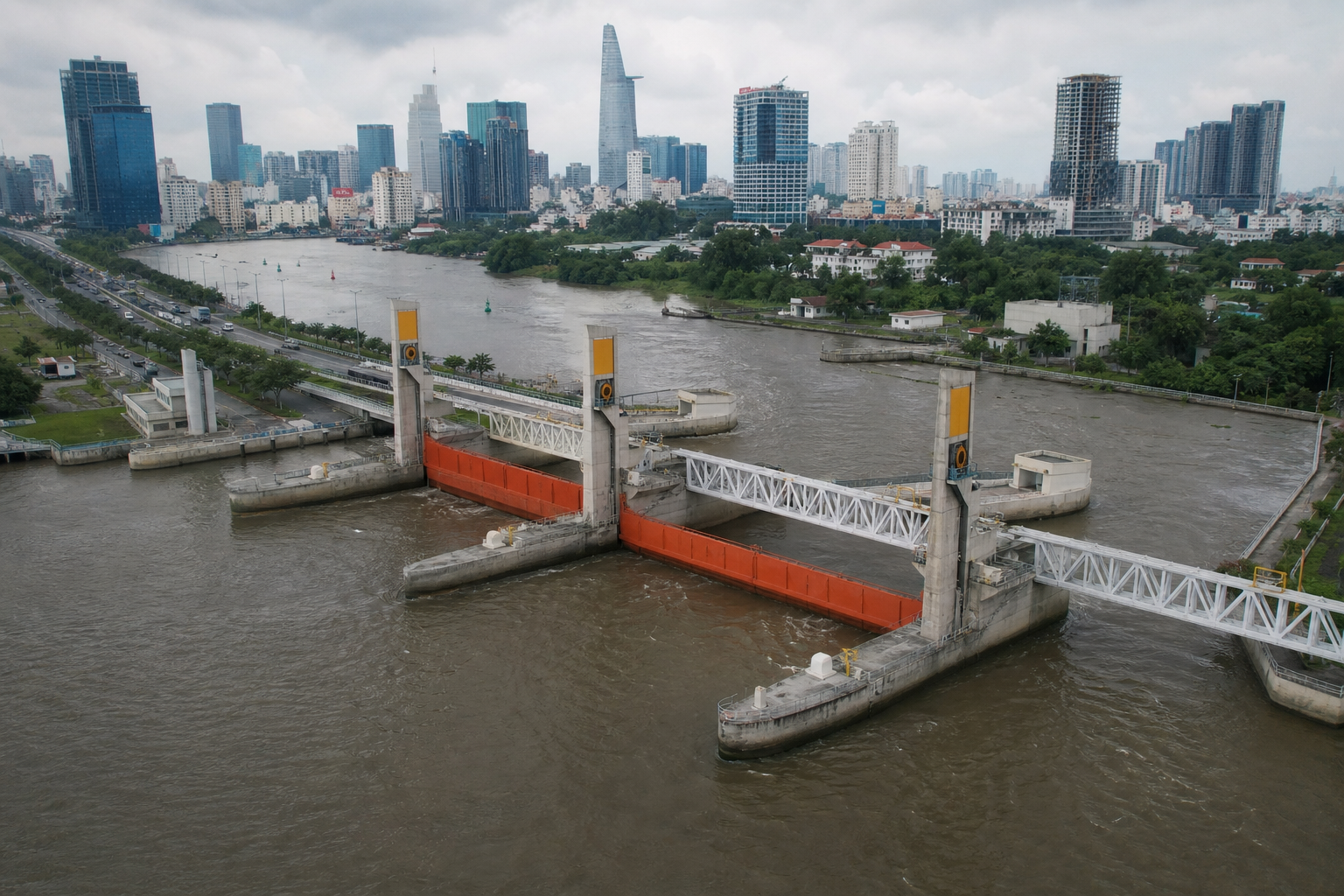
Launched in 2016 under a build-transfer (BT) contract worth nearly VND 10,000 billion, the scheme was designed to shield a 570 km² catchment area along the Saigon River — home to approximately 6.5 million residents — from chronic tidal flooding. The infrastructure package includes six tidal sluice gates ranging from 40 to 160 metres wide and more than 7.8 kilometres of riverside embankment. Completion was originally scheduled for 2018.
Three Stoppages and a Structural Flaw
The project has been suspended three times, the longest halt running from November 2020 until late 2025 — a five-year freeze during which physical progress sat at roughly 90%. The core problem is structural: the BT model requires the city to compensate the developer with land parcels rather than cash, but disputes over land valuation, title issuance, and contract terms have never been fully resolved. Without confirmed land assets, Trung Nam An Trieu cannot service its BIDV loans — of the VND 2,535 billion owed, only about VND 486 billion has been repaid, leaving nearly VND 2,050 billion outstanding. The overdue status has pushed the loans into non-performing territory, further cutting off the developer's access to fresh credit.
The Land-for-Infrastructure Bottleneck
Trung Nam An Trieu is now asking Ho Chi Minh City to sign a BT contract addendum by July 2025 to reset the total investment figure, redefine the land-payment pool, and formalise outstanding issues accumulated over nearly a decade. The developer specifically proposes adding two central city plots — at 257 Tran Hung Dao and 79B Ly Thuong Kiet — to the contract. For land parcels already allocated by government decision but lacking formal valuation or land-use certificates, the company wants city authorities to complete paperwork quickly so those assets can serve as collateral for bank financing. The land-title gap is the single largest obstacle preventing the project from resuming full financial momentum.

Government Response
Recent conclusions from national government leadership indicate that Ho Chi Minh City holds sufficient authority to resolve the remaining disputes without waiting for central intervention. The city's People's Committee chairman has been directed to coordinate with the developer and push for a clean resolution that avoids state asset losses or irregularities. The Ministry of Finance, the State Bank of Vietnam, BIDV, and related agencies have been tasked with providing guidance. The developer, for its part, must work proactively with city officials to agree on a settlement pathway and complete the project within 2026.

Where Things Stand Now
Construction resumed in late 2025, and physical completion has since climbed to above 93%. Around 600 engineers, workers, and support staff are currently on site. Remaining tasks are largely installation-phase work: fitting out equipment, deploying the SCADA control system, finishing administration buildings, landscaping around the sluice gates, and completing several embankment and revetment sections. A 2026 completion target is now in place.
Investor Takeaway
The Ho Chi Minh City tidal barrier saga illustrates the financial risk embedded in Vietnam's BT infrastructure model, where developer returns depend entirely on the state's ability to deliver land compensation on schedule. Delays in land valuation and title transfer can convert what looks like a public-private partnership into a de facto unsecured loan to the government — one accruing interest daily. For investors evaluating BT or PPP deals elsewhere in Vietnam, the resolution mechanism for non-cash compensation deserves the same scrutiny as the underlying project economics.