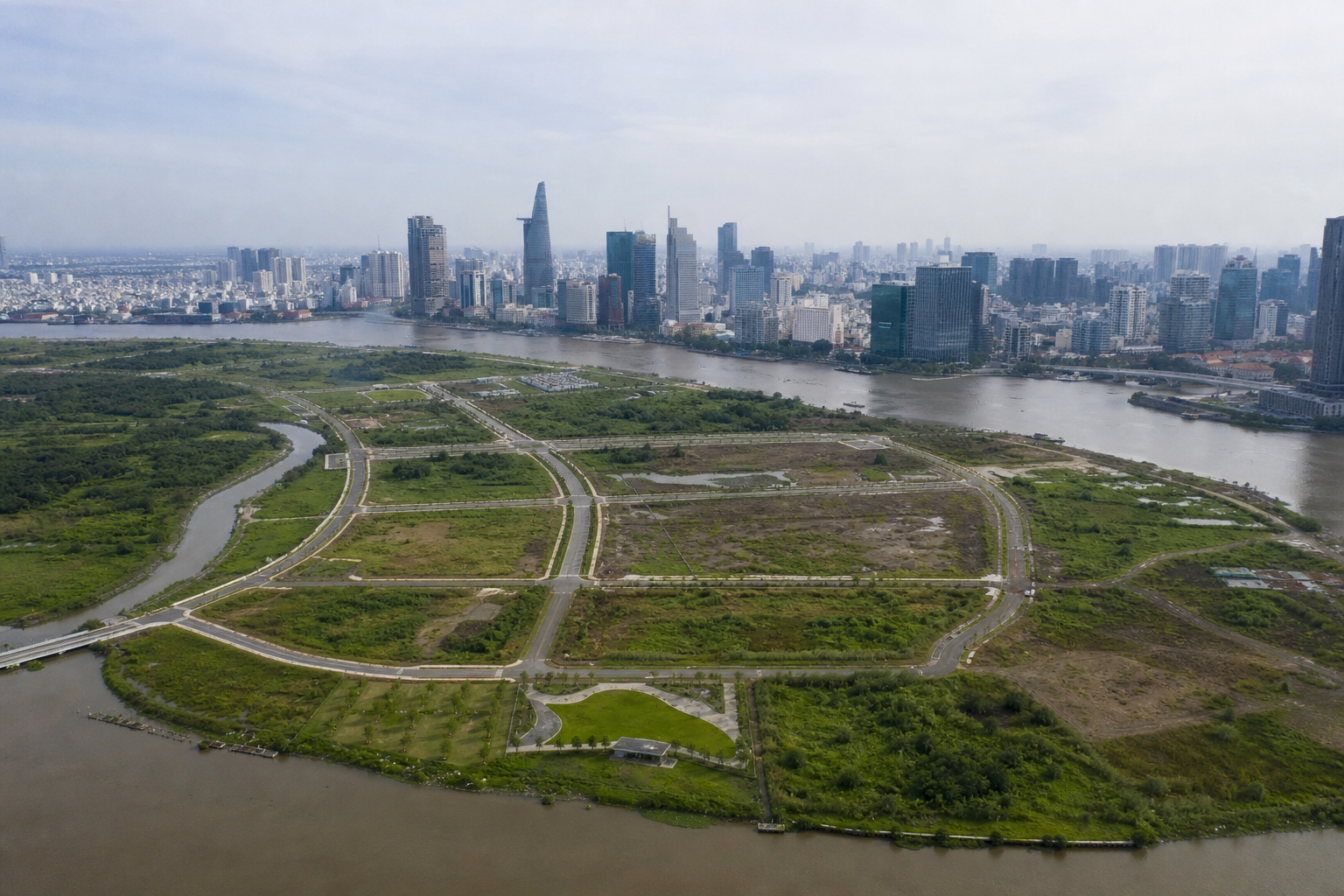
Ho Chi Minh City, home to nearly 14 million people and responsible for close to a quarter of Vietnam's GDP, is pushing toward a sweeping institutional reform that its leaders describe as a second Doi Moi. The immediate symbol of this shift is the Ma Lang quarter in District 1, where a redevelopment project frozen for 25 years finally secured a 16,300-billion-dong investment approval in June 2025.
A Quarter-Century Stalemate Breaks
The Ma Lang block — 6.8 hectares wedged between Nguyen Trai, Cong Quynh, Tran Dinh Xu, and Nguyen Cu Trinh streets — was earmarked for urban renewal before 2000. Over more than 1,400 households lived in deteriorating homes they were legally barred from repairing while the project cycled through multiple developers and repeated delays. The frustration peaked at a 2017 community meeting when one resident told city officials the city owed residents an apology.
The Ho Chi Minh City People's Council approved the Ma Lang–Cho Ga–Gao redevelopment plan on June 19, clearing land clearance to begin in August and construction to run through 2026–2029. The finished district will include a 38-storey social-housing tower with 1,400 apartments, 93 low-rise homes, and a multi-level school. A second tower of roughly 35 storeys with 760 units will replace the adjacent market area. That a project stuck for a quarter-century was resolved in three months signals what city officials call a qualitative shift in how Ho Chi Minh City now operates.

The City as Reform Laboratory
Ho Chi Minh City's role as a policy testing ground predates the national Doi Moi of 1986. In the late 1970s, city managers quietly expanded enterprise autonomy while the rest of the country still operated under central planning. Those experiments fed directly into the reforms adopted nationally in 1986. In the early 1990s the city launched Tan Thuan Export Processing Zone — Vietnam's first — and later pioneered municipal bond issuance and the urban development investment fund HIFU to finance infrastructure off-budget.
According to economist Tran Du Lich, former director of the Ho Chi Minh City Institute for Development Studies, the city's defining contribution has not been its tax revenue but its function as a proving ground for policies later scaled nationally. That track record now frames the argument for giving the city a governance structure that matches its economic weight.
The Institutional Bottleneck
After 2010 a gap opened between the city's pace of urbanisation and the legal framework governing it. Population growth, rapid property development, and a sprawling metropolitan economy all outran rules designed for a typical Vietnamese province. Senior National Assembly delegate Tran Hoang Ngan has argued directly that "an economy accounting for nearly a quarter of national GDP cannot keep operating under the same management mechanisms as ordinary localities."
The chokepoint identified after years of review was not money but time. City officials found that major programmes — canal-side housing renovation, urban rail — stalled because they required sign-off at multiple levels of government, each with its own procedural timeline. Former city chairman Phan Van Mai, now chair of the National Assembly's Economic and Financial Committee, summarised the lesson bluntly: the city did not lack resources, it lacked the institutional authority to move quickly.
Legislative Milestones
The national government has responded in stages. The National Assembly passed Resolution 54 in 2017, giving Ho Chi Minh City its first pilot authorisation to experiment with special mechanisms on finance, investment, and land. A post-pandemic Politburo resolution (Resolution 31) then designated the city as the country's economic, financial, and science-and-technology centre and called for superior mechanisms to match that status.
Building on those foundations, the National Assembly enacted Resolution 98 and subsequently Resolution 260, each expanding the city's special-status toolkit. Parallel revisions to the Land Law, Housing Law, Real Estate Business Law, Investment Law, Bidding Law, and PPP Law have collectively shifted more decision-making power to the local level. Even so, officials acknowledge the general framework still falls short: the city needs mechanisms calibrated to its own specific development targets, not just looser national rules.

Mobilising Private Capital
The Ma Lang project illustrates a broader funding philosophy. The city used a PPP structure with a BT contract, meaning private developers will finance integrated infrastructure and build replacement social housing on-site. To reach that point, the city's submission had to satisfy more than 15 separate laws, one Politburo resolution, two special National Assembly resolutions, and four government decrees — a compliance burden that itself underscores why streamlined governance matters.
The city's position, articulated by Tran Hoang Ngan, is that it does not need larger budget transfers from Hanoi. What it needs is an institutional framework strong enough to channel private and market capital into urban development — a goal the city has pursued for decades but never fully achieved.
Investor Takeaway
For investors tracking Vietnam's urban real estate, infrastructure, and PPP pipeline, the Ho Chi Minh City reform story carries concrete implications. Faster project preparation, clearer land-clearance timelines, and greater local decision-making authority reduce the execution risk that has historically deterred long-cycle infrastructure capital. The Ma Lang approval — from concept revival to council vote in roughly three months — sets a new benchmark. If Resolution 260 and associated legal revisions deliver the institutional agility the city's leadership is promising, Ho Chi Minh City's long backlog of stalled urban projects could move from liability to opportunity within this planning cycle.

Images: Pixabay